Underwriting Optimization
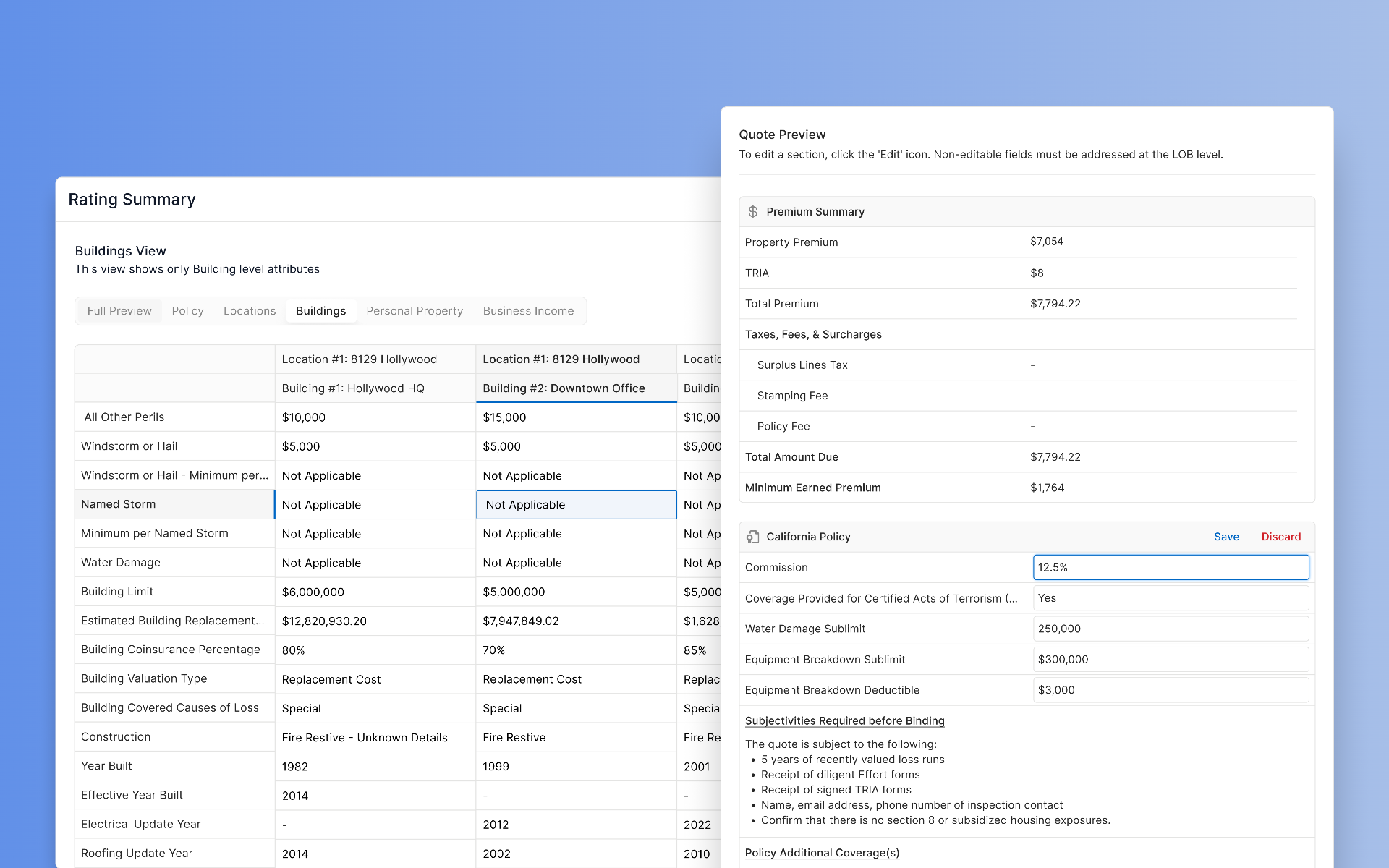
Redesigned Joyn's underwriting workflow so critical financial and property details live in one view instead of scattered tabs. Underwriters doubled their quoting output without sacrificing turnaround time.
- Role
- Founding Product Designer & Product Manager
- Team
- 1 Design, 3 Engineering
- Timeline
- 2 months
- Outcome
- 2x productivity
Background
Mission
Joyn is a managing general agent (MGA) that underwrites and quotes commercial insurance. Their underwriting team couldn't keep up with quote volume. Spark, the internal tool, wasn't built for the underwriting workflow, and turnaround times were slipping.
Our role
Find the friction in the quoting process. Design features that cut quoting time without sacrificing accuracy.
The Problem
Underwriters were struggling to keep up with quote volume. Turnaround times from 'Ready for Underwriting' to 'Quoted' were too slow, and Spark wasn't designed with the underwriting experience in mind.
Underwriters
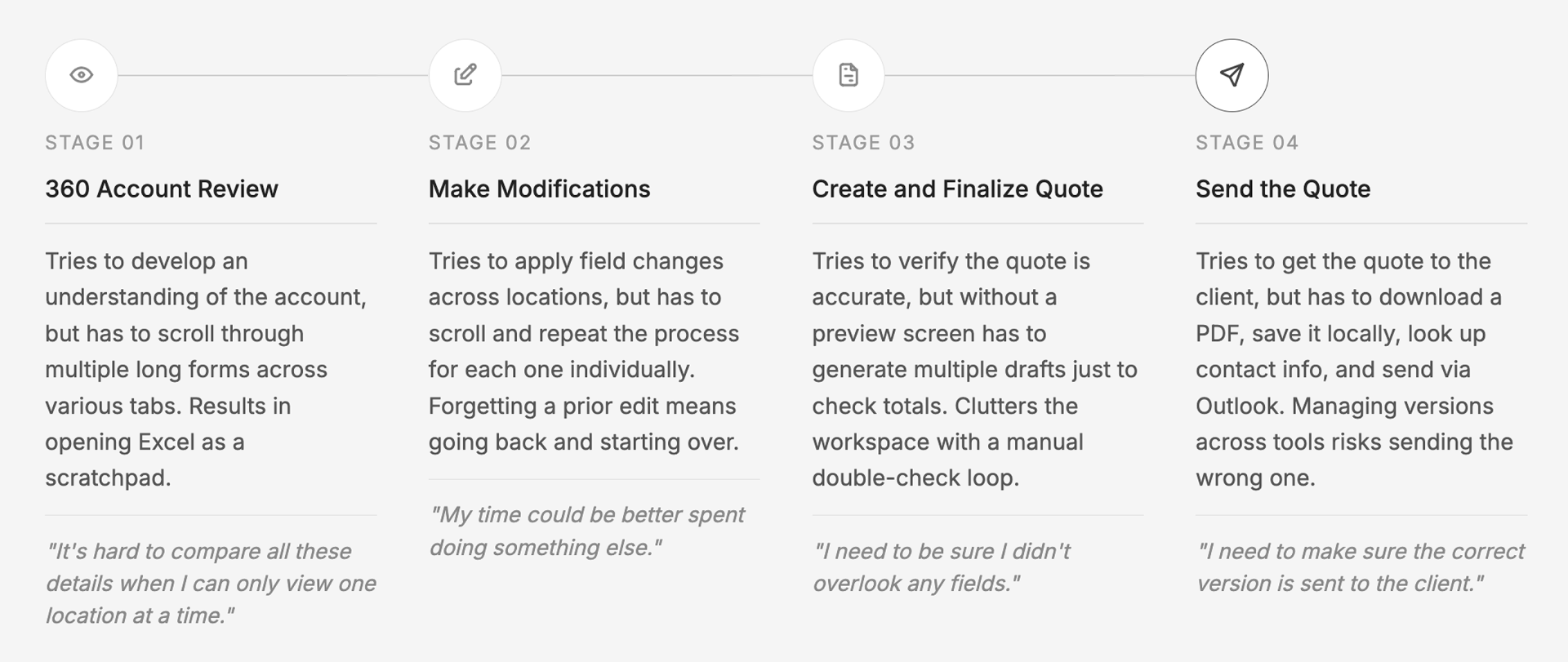
After shadowing every underwriter, observing live submissions and following up with 1:1 sessions, core friction points surfaced.
No consolidated view of critical data
Spark forced users to scroll through long forms and tabs to compare data across multiple locations. Many underwriters resorted to Excel just to make sense of the information in front of them.
No way to preview quotes
Without a preview screen, underwriters created multiple draft quotes just to verify totals: a slow, error-prone workaround that added unnecessary steps to every submission.
No ability to send quotes in-app
To send a quote, underwriters had to download a PDF and manually email it through Outlook. The tool stopped short of the finish line, adding friction at the most critical moment.
Approach & Process
Research & Validation
Shadowing our underwriters surfaced a deeper issue: Underwriting at Joyn lacked a shared playbook. Before any UI could land, we had to align on how the team worked and who held the quality bar.
| Unanswered question | How we aligned |
|---|---|
Who owns the golden standard of underwriting? Everyone had their own tools, resources, and quoting logic | Defined a shared review process with UW Ops, underwriting leads, the Chief Underwriting Officer, and CEO |
What information actually matters? No agreement on which fields drive decisions and every underwriter valued different data points | Identified key decision-driving fields per product type and grouped them in the UI by decision flow |
Which external tools do we trust? No shared standard for which third-party sources carried the most weight in underwriting decisions | Agreed on trusted data sources as a product decision before any UI could land |
How should quote files be named? No consistent naming convention for quote files | Introduced standardized file naming logic in the send quote flow |
What templates should we use when sending quotes? No shared language when sending quotes or interfacing with clients | Integrated dynamic templates tied to submission data |
Underwriting wanted Spark Sheets: a full Excel-like editing experience in-app, including multi-cell updates, undo/redo, copy/paste, keyboard shortcuts, and the ability to hide/freeze rows and columns. Engineering flagged major risks: our data model couldn't support real-time edits at that scale.
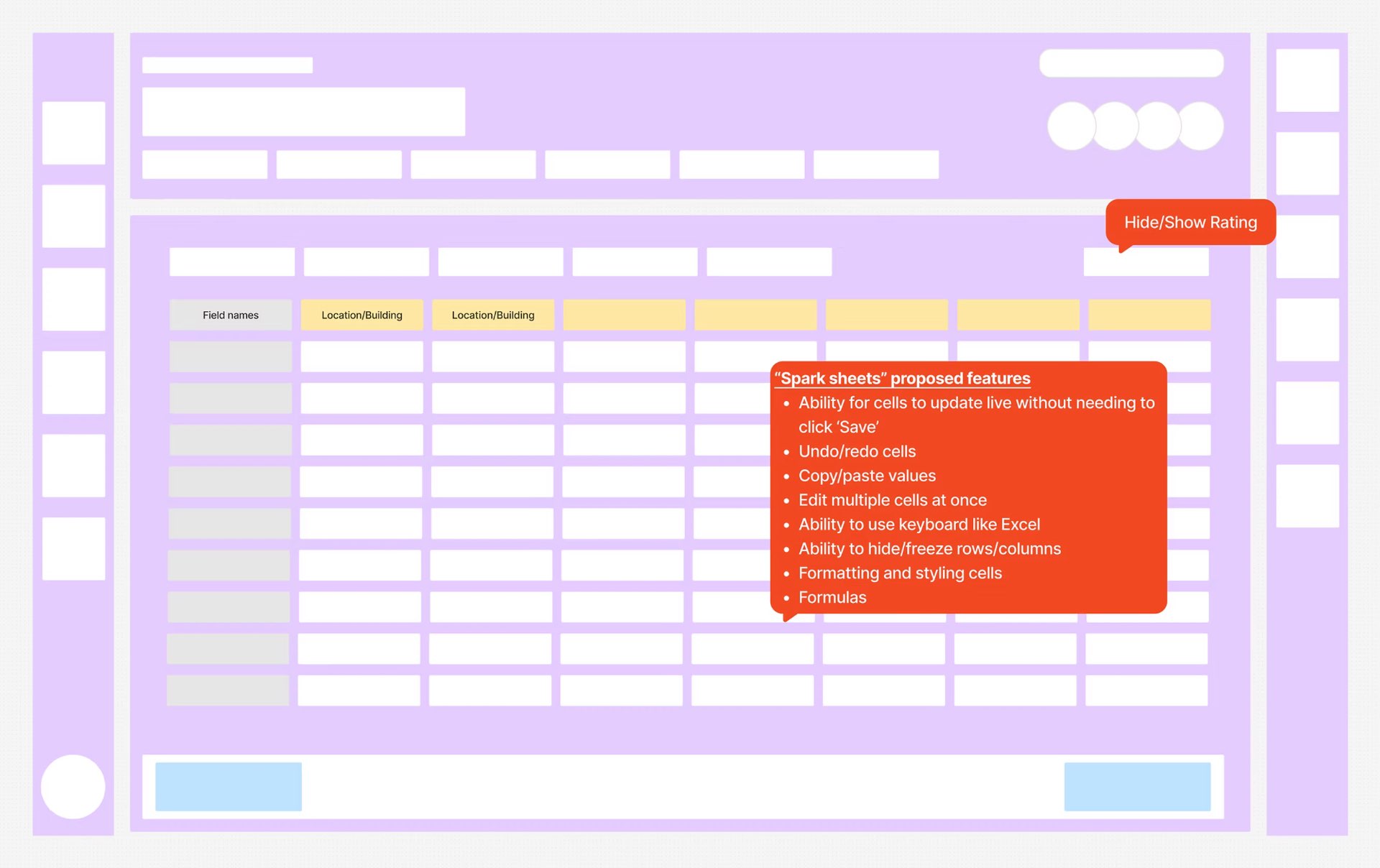
Initial Spark Sheets proposal — a full Excel-like editing experience.
To move forward, I aligned both teams around a scoped solution: Rating Summary would offer a read-only, spreadsheet-style view, and Quote Preview would support confident final checks before sending.
This compromise preserved performance while meeting the core visibility needs underwriters actually needed.
The Solution
I finalized designs in collaboration with users, then presented to engineering. I created tickets for the front-end team and tested PRs in partnership with QA before each feature was deployed.
Results & Impact
As Joyn faced unprecedented product volume in 2024, the features helped underwriters maintain consistent quoting speed despite the team size staying relatively unchanged.
Learnings & Reflection
This project taught me that the most valuable thing I can do as a designer isn't always making the interface better. Sometimes it's making sure processes are standardized and called to attention. We defined what it meant to be an underwriting at Joyn.